FACEBOOK PASSWORD USING BRUTE FORCE ATTACK (99% WORKING)
Note:- This Article Is Not or Noobs! Learners Are Welcomed! this Article Is For Educational Purposes Only, Any Misuse Of Information Given Below Is Prohibited! We Will Not Be Responsible For Malfunctions Mad By You.
Hi Friends! I am back with a fresh tutorial here, and this time its on hacking facebook! The method I am going to use here will be brute forcing, Using World’s Best Passwords Dictionary, CrackStation,
So, First lets know something about Brute force attacks,
“A brute force attack is a trial-and-error method used to obtain information such as a user password or personal identification number (PIN). In a brute force attack, automated software is used to generate a large number of consecutive guesses as to the value of the desired data.”
But, In our case I’ll be using a Python script and a Long Dictionary Of passwords. I have personally tried it on myself and it really works :) .
Here’s the list of what we need:
A Kali Machine / Or Any Python Engine Will work!
Facebook.py ( v1 or v2 <v1 Recommended Because Not Used v2 yet!>)
step 1. Install Python-mechanize using command mention below
[*] root@root:~#apt-get install python-mechanize
step 2.
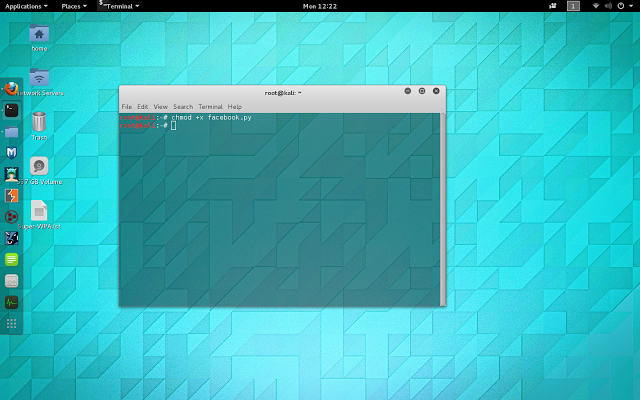
Add facebook.py using the command below
[*] root@root~# chmod +x facebook.py
[*] root@root:~# python facebook.py
step 3.
Now enter |Email| or |Phone number| or |Profile ID number| or |Username| of the victim, You can use graph.facebook.com for more information!
Step 4 .
Now Give The Path Of Your CrackStation Word list !
step 5.
Now it will try all passwords present in the word list, So relax and have a cup of coffee because it will take time depending on speed of your processor and password strength of your victim!
Hope this article was helpful :) Any feedback or Questions? Leave a Comment And I’ll be Happy To Help.
Dr. Web discovered a New Trojan in Linux!
All user thinks that OS X and Linux are safe as compare to Windows, against malicious attacks. But this belief is totally wrong. OS X is on the top for having maximum Vulnerabilities in 2015 and It's Gatekeeper is also vulnerable. If we talk about Linux, Dr. Web (A Russian Security Firm) found a new Trojan Dubbed “Linux.Ekoms.1”
which is targeting users by taking screenshots of their systems after
every 30 seconds. It is a bad news for Linux users. Linux also had been
targetted by a ransomware called “Linux.Encoder” in October, 2015.
Dr.
Web said that Linux.Ekoms.1 Trojan is a different type of danger for
Linux users. Once it got entry in the system of user, it could be
harmful for user in many forms. This Trojan is capable to take screenshots of victim's computer after every 30 seconds and can save these screenshots in .JPEG or BMP
format on the remote server with the extension “.sst”. It can also
record sounds of system and save them in WAV format using extension
“.aat”.
This Trojan checks the temporary files folder to scan its
file because it is capable to download and upload files from this folder
to the remote server. The address of the remote server
is present in this Trojan in Hardcoded Scripts. After activation,
Trojan mainly search for two files “$HOME/$DATA/.dropbox/DropboxCache” and “$HOME/$DATA/.mozilla/firefox/profiled”.
If
Trojan did not found these two files, it will save some new files by
itself with a new name in temporary folder. These files will establish
connection between Trojan and Remote Server. This remote server has the
control of Trojan “Linux.Ekoms.1”. All the information sent by Trojan to
the server will be in Encrypted form. This Trojan have
a number of features, which are dangerous for user. This Trojan can
enable and disable a number of services of user's system
automatically.The Trojan sends the screenshots of victim's system to
remote server and by analysing these screenshots hackers can steal the
sensitive information of user.
There is no information about, how
this Trojan enter in the system of Linux user. But it should not be
underestimated because it is a big danger for Linux users as it has many
features which can steal the sensitive information of user.
Motion-planning algorithms allow drones to do donuts, figure-eights in object-filled environments.
(MIT NEWS Adam Conner-Simons | CSAIL)
Getting
drones to fly around without hitting things is no small task.
Obstacle-detection and motion-planning are two of computer science’s
trickiest challenges, because of the complexity involved in creating
real-time flight plans that avoid obstacles and handle surprises like
wind and weather.
In a pair of projects announced this week, researchers from MIT’s Computer Science and Artificial Intelligence Laboratory
(CSAIL) demonstrated software that allow drones to stop on a dime to
make hairpin movements over, under, and around some 26 distinct
obstacles in a simulated “forest.”
One team’s video shows a small quadrotor doing donuts and
figure-eights through an obstacle course of strings and PVC pipes.
Weighing just over an ounce and clocking in at 3 and a half inches from
rotor to rotor, the drone can fly through the 10-square-foot space at
speeds upwards of 1 meter per second.
The team’s algorithms, which are available online and were previously used to plan footsteps for CSAIL’s Atlas robot at last year's DARPA Robotics Challenge, segment space into “obstacle-free regions” and then link them together to find a single collision-free route.
“Rather than plan paths based on the number of obstacles in the
environment, it’s much more manageable to look at the inverse: the
segments of space that are ‘free’ for the drone to travel through,” says
recent graduate Benoit Landry '14 MNG '15, who was first author on a
related paper just accepted to the IEEE International Conference on
Robotics and Automation (ICRA). “Using free-space segments is a more
‘glass-half-full’ approach that works far better for drones in small,
cluttered spaces.”
In a second CSAIL project, PhD student Anirudha Majumdar showed off a
fixed-wing plane that is guaranteed to avoid obstacles without any
advanced knowledge of the space, and even in the face of wind gusts and
other dynamics. His approach was to pre-program a library of dozens of
distinct “funnels” that represent the worst-case behavior of the system,
calculated via a rigorous verification algorithm.
“As the drone flies, it continuously searches through the library to
stitch together a series of paths that are computationally guaranteed to
avoid obstacles,” says Majumdar, who was lead author on a related
technical report. “Many of the individual funnels will not be
collision-free, but with a large-enough library you can be certain that
your route will be clear.”
Both papers were co-authored by MIT professor Russ Tedrake; the ICRA
paper, which will be presented in May in Sweden, was also co-written by
PhD students Robin Deits and Peter R. Florence. Drones in high-density
A bird might make it seem simple, but flight is a highly complicated
endeavor. A flying object can change position in six distinct directions
— forward/backward (“surge”), up/down (“heave”), left/right (“sway”),
and by rotating front-to-back (“pitch”), side-to-side (“roll”), and
horizontally (“yaw”).
“At every moment in time there are 12 distinct numbers needed to
describe where the system it is and how quickly it is moving, on top of
simultaneously tracking other objects in the space that could get in
your way,” says Majumdar. “Most techniques typically can’t handle this
sort of complexity in real-time.”
One common motion-planning approach is to sample the whole space through algorithms like the “rapidly-exploring random tree.”
Although often effective, sampling-based approaches are generally less
efficient and have trouble navigating small gaps between obstacles.
Landry’s team opted to use Deits’ new free-space-based technique,
which he calls the “Iterative Regional Inflation by semidefinite
programming” algorithm (IRIS). They then coupled IRIS with a
“mixed-integer semidefinite program” (MISDP) that assigns specific
flight movements to each “space-free region” and then executes the full
plan.
To sense its surroundings, the drone used motion-capture optical
sensors and an on-board inertial measurement unit (IMU) that help
estimate the precise positioning of obstacles.
“I’m most impressed by the team’s ingenious technique of combining
on- and off-board sensors to determine the drone's location,” says
Jingjin Yu, an assistant professor of computer science at Rutgers
University. “This is key to the system’s ability to create unique routes
for each set of obstacles."
In its current form, MISDP has been optimized such that it can’t do
real-time planning; it takes an average of 10 minutes to create a route
for the obstacle course. But Landry says that making certain sacrifices
would let them generate plans much more quickly.
“For example, you could define ‘free-space regions’ more broadly as
links between areas where two or more free-space regions overlap,” says
Landry. “That would let you solve for a general motion-plan through
those links, and then fill in the details with specific paths inside of
the chosen regions. Currently we solve both problems at the same time to
lower energy consumption, but if we wanted to run plans faster that
would be a good option.”
Majumdar’s software,
meanwhile, generates more conservative plans, but can do so in
real-time. He first developed a library of 40 to 50 trajectories that
are each given an outer bound that the drone is guaranteed to remain
within. These bounds can be visualized as ”funnels” that the planning
algorithm chooses between to stitch together a sequence of steps that
allow the drone to plan its flying on the fly.
A flexible approach like this comes with a high level of guarantees
that the software will work, even in the face of uncertainties with both
the surroundings and the hardware itself. The algorithm can easily be
extended to drones of different sizes and payloads, as well as ground
vehicles and walking robots.
As for the environment, imagine the drone choosing between making a
forceful roll maneuver that will avoid a tree by a large margin, versus
flying straight and avoiding a tree by a small amount.
“A traditional approach might prefer the first since avoiding
obstacles by a significant amount seems ‘safer,’” Majumdar says. “But a
move like that actually may be riskier because it’s more susceptible to
wind gusts. Our method makes these decisions in real-time, which is
critical if we want drones to move out of the labs and operate in
real-world scenarios.” A clear path to avoiding obstacles
CSAIL researchers have been working on this problem for many years. Professor Nick Roy has been honing algorithms for drones to develop maps and avoid objects in real-time; in November a team led by PhD student Andrew Barry published a video demonstrating algorithms that allow a drone to dart between trees at speeds of 30 miles per hour.
While these two drones cannot travel quite as fast as Barry’s, their
maneuvers are generally more complex, meaning that they can navigate in
smaller, denser environments.
“Enabling dynamic flight of small, off-the-shelf quadcopters is a
marvelous achievement, and one that has many potential applications,” Yu
says. “With additional development, I can imagine these machines being
used as probes in hard-to-reach places, from exploring caves to doing
search-and-rescue in collapsed buildings.”
Landry, who now works for 3D Robotics
in California, is hopeful that other academics will build on and refine
the researchers’ work, which is all open-source and available on
github.
“A big challenge for industry is determining which technologies are
actually mature enough to use in real products,” Landry says. “The best
way to do that is to conduct experiments that focus on all of the corner
cases and can demonstrate that algorithms like these will actually work
99.999 percent of the time.”
Landry's work was partially supported by the Siebel Scholars
Foundation, while Majumdar's work was supported by a grant from the
Office of Naval Research.
Organ-on-a-chip
In a step toward personalized drug testing, researchers coax human stem cells to form complex tissues.
(Helen Knight | MIT News correspondent)
A
new technique for programming human stem cells to produce different
types of tissue on demand may ultimately allow personalized organs to be
grown for transplant patients.
The technique, which also has near-term implications for growing
organ-like tissues on a chip, was developed by researchers at MIT and is
unveiled in a study published today in the journal Nature Communications.
Growing organs on demand, using stem cells derived from patients
themselves, could eliminate the lengthy wait that people in need of a
transplant are often forced to endure before one becomes available.
It could also reduce the risk of a patient’s immune system rejecting
the transplant, since the tissue would be grown from the patient’s own
cells, according to Ron Weiss, professor of biological engineering at
MIT, who led the research.
“Imagine that there is a patient with liver complications,” Weiss
says. “We could take skin cells from that person and then [convert] them
into stem cells, and then genetically program them to make the liver
tissue, and transplant that into the patient.” A rudimentary organ
The researchers developed the new technique while investigating
whether they could use stem cells to produce pancreatic beta cells for
treating patients with diabetes.
In order to do this, the researchers needed to devise a means to convert stem cells into pancreatic beta cells on demand.
As a first step in this process, they took human induced pluripotent
stem (IPS) cells — stem cells generated from adult fibroblast, or skin
cells — and converted them into “endoderm,” one of the three primary
cell types in a developing organism. Endoderm, mesoderm, and ectoderm
make up the three so-called germ layers that contribute to nearly all of
the different cell types in the body. “They are the first real step of
[cell] differentiation,” Weiss says.
The researchers developed a method to use a type of small molecule
called dox to induce the IPS cells to express a protein known as GATA6.
This protein can convert IPS cells into endoderm.
Rather than immediately attempting to convert these endoderm cells
into pancreatic cells though, the paper’s lead author, Patrick Guye, a
former postdoc in Weiss’ lab and currently laboratory head with
Sanofi-Aventis in Frankfurt, Germany, then decided to allow the cells to
continue growing, to monitor their progress.
After two weeks, the researchers found that the endoderm, and some
mesoderm also present in the cell culture, had matured further, to form a
liver “bud,” or small, rudimentary liver.
“We observed the development of many cells types found in the fetal
liver, including the development of blood vessel-like networks, various
mesenchymal precursors, and the formation of early red and white blood
cells within our liver-like tissue,” Guye says. “This is especially
exciting, as the process looks very similar if not identical to what is
happening in the early liver bud in vivo, that is, in our own
development.”
What’s more, the researchers discovered that only those IPS cells
that had been exposed to more of the genetic programming, and had
therefore gone on to produce more GATA6, became liver tissue. Alongside
these were IPS cells that did not make much GATA6, which went on to form
ectoderm instead, and then further matured to become early
telencephalon, or forebrain.
By controlling how much GATA6 the cells expressed, the researchers
were able to determine how much liver bud and how much forebrain tissue
was generated, Weiss says.
This suggests that the technique could be used to produce not just
individual tissue types, but different combinations of tissue, he says.
“The fact that we are able to produce endoderm, mesoderm, and
ectoderm gives us great hope that we can take each of these germ layers
and hopefully grow any kind of tissue we want,” he says. Liver-on-a-chip
While it is likely to be some time before the technique can be used
to generate transplant organs, it could be used almost immediately to
grow different human tissue on which to test new drugs, Weiss says.
Using human stem cell-derived organ tissue to test new treatments
could be far more reliable than testing on animals, since different
species may react differently to a drug, he says.
The technique could also allow clinicians to carry out
patient-specific drug testing. “If you are not sure whether you will
have complications from taking a particular drug, then before you take
it you could try it out on your own liver-on-a-chip,” Weiss says.
Similarly, the organ-on-a-chip could be used to monitor the interaction between different drugs that people may be taking.
“As people age, some are taking 10, 15, or 20 drugs together, and
it’s impossible for the pharmaceutical companies to test all of these
combinations for every individual. But we would be able to test that
out,” he says. “That is something that can be done now.”
In addition to these therapeutic applications, the technique could
allow researchers to gain a better understanding of the development of
different types of tissue, such as the liver and neurons.
The paper reveals some intrinsic mechanisms underlying the
interactions of stem cells during liver development, and provides a
useful model that sheds light on the complex process of embryogenesis,
says Bing Song, a professor of tissue engineering at Cardiff University
in the UK, who was not involved in the research.
"In my field, which is combining genetically modified stem cells and
physical stimulation (electrical and magnetic) to cure spinal cord
injuries and degenerative disease, the paper has given me some very
useful ideas," he says.
The researchers now hope to investigate whether they can use the technique to grow other organs on demand, such as a pancreas.
r4hu1
Based
upon the industry reviews and our own experience, here is a compilation
of the top Android hacking applications. Along with the description of
apps, we have provided the relevant website and download links to help
you get started instantly. Disclaimer:Please note that we're publishing this list just for educational
purposes. We don’t support use of any tool to indulge in some unethical
purposes.
AndroRAT
AndroRAT stands for Android and RAT (Remote Administrative Tools).
This top hacking tool was released a long time ago as a client/server
application. The app aims to give you the control of the Android system
remotely and fetch the information from it. This Android app runs as a
service right after the boot. So, a user doesn’t need to interact with
the service. The app provides you the ability to trigger the server
connection by a call or SMS.
The features in this useful Android hacking app include collecting
information like contacts, call logs, messages, and location. The app
also allows you to remotely monitor received message and state of phone,
making a phone call and sending texts, taking picture from camera,
opening URL in the default browser etc.
Hackode
Hackode is an Android app which is basically a collection of multiple
tools for ethical hackers, IT specialists, and penetration testers. In
the app, there are three modules –Reconnaissance, Scanning, Security
Feed — available in the application.
With this app, you get the functionalities like Google hacking, SQL
Injection, MySQL Server, Whois, Scanning, DNS lookup, IP, MX Records,
DNS Dif, Security RSS Feed, Exploits etc. It’s a great Android hacking
app to start with and it doesn’t ask for your private information to
operate
.
— Hackode
zANTI
zANTI is a reputed Android hacking suite from Zimperium. This
software suite comes with multiple tools that are widely used for
penetration testing purposes. This mobile penetration testing toolkit
allows the security researchers to scan a network easily. This toolkit
allows the IT administrators to simulate an advanced hacking environment
to detect multiple malicious techniques.
zANTI could be called an app that brings the power of Backtrack on
your Android device. As soon as you login into zANTI, it maps the entire
network and sniffs the websites being visited along with their cookies —
thanks to ARP cache poisoning on devices.
The various modules in the app are network mapping, port discovery, sniffing, packet manipulation, DoS, MITM, and more.
FaceNiff is a top Android hacking app that allows you to intercept
and sniff your WiFi network traffic. This tool is widely used to snoop
into people’s Facebook, Twitter and other social media websites using
your Android device. This hacker-favorite tool steals cookies from WiFi
network and gives an attacker an unauthorised access to victim’s
account.
FaceNiff is developed by Bartosz Ponurkiewicz — the same developer who wrote Firesheep for Firefox hacking on desktop.
Droidsheep is an effective hacking app developed for security
analysts interested in playing with Wi-Fi networks. The app has the
ability to hijack the web session profiles over a network and it works
with almost all services and websites.
As you fire up the Droidsheep app, it acts a router that monitors and
intercepts all the Wi-Fi network traffic and fetches the profiles of
active sessions. With this app, one can sniff Facebook, LinkedIn,
Twitter and other social media accounts.
DroidSheep Guard, another version of app, helps you to detect
ARP-Snoofing on the networks i.e. the attacks by FaceNiff, Droidsheep,
and other software.
DroidBox is an app that offers dynamic analysis of Android
applications. Using the app, one can get a wide range of results about
the hashes for the APK package, network traffic, SMS and phone calls,
information leaks via different channels etc.
This top Android hacking application also gives you the ability to visualize the behaviour of an Android app package
APKInspector
APKInspector is an app that allows you to perform reverse
engineering
tricks. With this app, you can get the graphic features and analysis
functions for the users to get a deep insight. This powerful Android
hacking tool helps you get the source code of any Android app and
visualize the DEX code to erase the credits and license.
One of the most popular network scanning apps for desktop can also be
used on Android operating system. Nmap works on both non-rooted and
rooted phones. If you are a beginner Android hacker, this hacking app
app is a must have.
SSHDroid
SSHDroid is a SSH server implementation developed for Android that
allows you to connect your Android device to a PC and run commands like
‘terminal’ and ‘adb shell’ and edit files. It provides an extra security
later when you are connecting to a remote machine.
The app provides features like shared-key authentication, WiFi autostart whitelist, extended notification control etc.
$55 million stolen by Hackers from Aircraft Company! Hackers hacked systems of FACC's (Aerospace
Parts Manufacturer company) financial accounting department and steal
$55 million from its money boxes. This company is one from the biggest
suppliers of US Aircraft company Boeing.Chinese
Aviation Corporation is the largest shareholder of this aircraft
company. Company is saying that their sensitive data and all the
intellectual property is safe. Only cash has been stolen by the Hackers.If this theft of $55 million
is accurate then it is a notable attack. According to Ponemon study of
last year, every data breach brings an average loss of $3.9 million for
affected company. Boeing is a client of an Austrian based comapny
and this company gave a statement by publishing a post on their
website,” It seems like hackers did not steal any intellectual data and
all the operations of company are safe and did not touched by the
Hackers.” FACC gave a clearification about this incident on January 19 of this year. The financial department of FACC was the target of Hakcers in this case, told by investigation team. Investigation Team
said all the IT infrastructure, information, IP rights and business
operations of company are safe because the hackers did not touch them.
The company is facing the loss of $55 million for which hackers attacked
on the company.
Management team of FACC is
evaluating the total damage due to this attack. Management team said
that this attack will not effect the production of company. Last year Ryanair Airline's budget database was hacked by hackers. This airline is the part of FACC. In that hack total damage was of $5 million. All the money was transffered to a Chinese Bank.
On Daily we
have heard news about online services is suffering from a lack of security. In
February WhatsApp has been down for nearly four hours, as if this were not
enough, people became aware of the security flaw that allows conversations that
should be read by anyone provided it learn properly perform the procedures.
Steps to follow:
1 -
First of all you need to have the device at hand, use the Social Engineering
and be quick in getting the e-mail and backup files msgstore-2014-05-02.1.db.crypt5. To get the email for this
follow the procedures below.
Enter the Play Store and view the e-mail, or write down mentalize somewhere
without the person noticing.
Now Go to the device settings from Settings ->
Accounts & Sync,
look for the email from Google and
mentalize or write down somewhere without the person noticing.
2 - Now
let's take the msgstore-2014-05-08.1.db.crypt7 file To do this, use Polaris Office or any other app that
allows you to navigate between folders and manage files.
Follow
this path: My files -> WhatsApp -> Databases - In this directory you will find all the backup files of
your messenger. When you do find the file sharing for your mobile phone via
bluetooth.
To Submit follows: Account:
Enter the email of the victim Database:
Select the database backup
Click Process /
download zip
Save the zip file
on your desktop
4 - Once you have downloaded the backup file in zip format we now need
to download the tool to extract the backup and we have access to conversations.
Save on the desktop.
5 - From the
desktop to extract the file WhatsApp Decrypt.zip
install python-3.4.0 folder and enter the WhatsApp.
Browse by: WhatsApp ->
Whatsapp_Xtract_V2.1_2012-05-10-2
When you
install python-3.4.0 do the following steps:
1 - Go
to My Computer, click with the right mouse button and Properties -> Advanced
System Settings
2 - In
the System Properties navigate to the Advanced
tab -> Environment Variables
3 -
Environment Variables look for Path
4 - Edit
the PATH
5 - At
the end of PATH add ;C:\Python34
6 - Click ok and close
6 - Now
extract the file from step 3 msgstore_decrypted
on the desktop, copy and paste it
on WhatsApp
folder -> Whatsapp_Xtract_V2.1_2012-05-10-2 and replace
the file
7 - Replace
the WhatsApp
folder -> Whatsapp_Xtract_V2.1_2012-05-10-2 from step 5 and look for msgstore.dll file,
drag it onto the whatsapp_xtract_drag'n'drop_database file (s) _here
After
you drag it will create a file called msgstore.db.html the folder and ask you
to press any key at the command prompt to continue ... Pressing any key it will
open in your default browser displaying the file msgstore.db.html all
conversations, dates, numbers, etc...
Note:In step 2 print shows the crypt 7 but the crypt is correct 5! Disclaimer:This tutorial is educational purpose only. We're not responsible for any kind of illegal activities. We believe in Security. (Source :-http://hackersonlineclub.com/hack-whatsapp-account/)